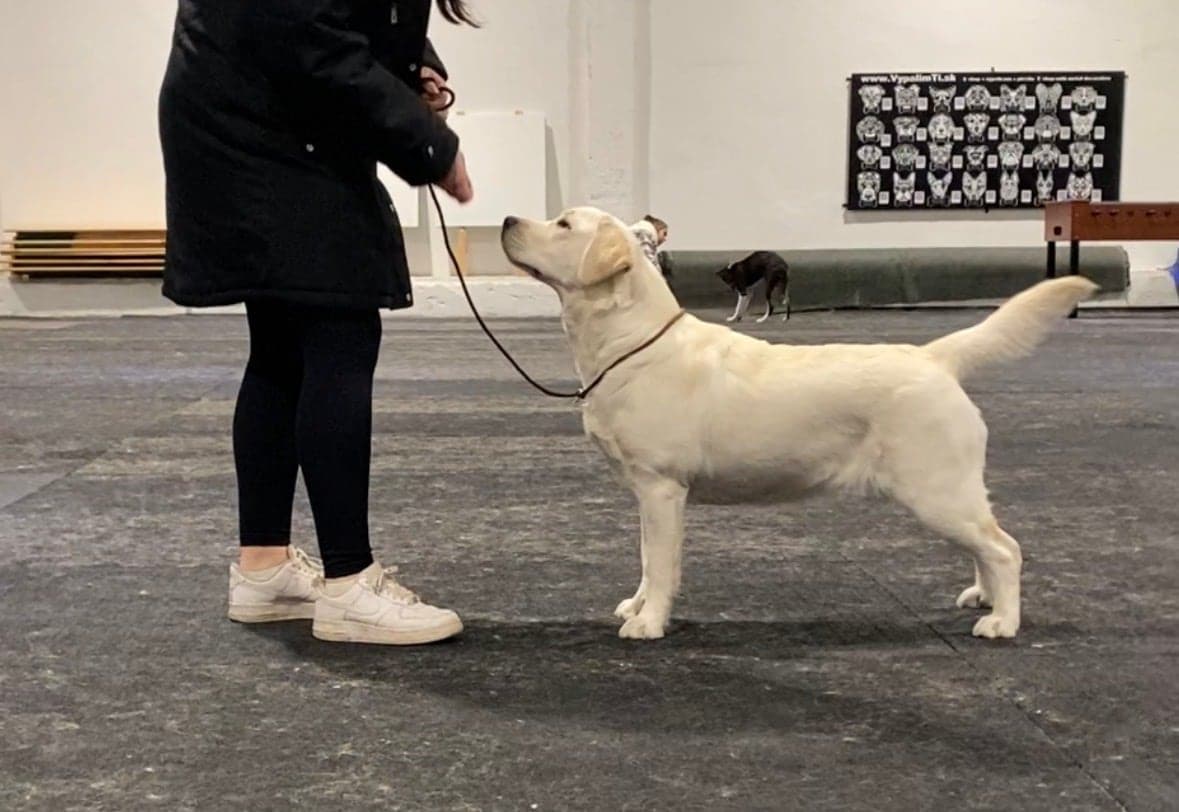
We are expecting black puppies from an international mating in the second half of October.
We are already accepting reservations for puppies from this litter.
Yes. All our puppies leave for their new homes with a pedigree certificate.
A pedigree certificate is a dog's "birth certificate." It confirms its origin, identity, and that it comes from a controlled breeding program. It's not only meant for show dogs. A puppy's price wouldn't be any lower without it, since issuing a pedigree certificate itself costs only a few euros.
Our puppies aren't merchandise to us. We look for a loving home for life for each one of them.
That's why we try to get to know future owners and find out whether a Labrador Retriever would be a good match for them specifically. It's equally important, though, that you get to know us and see the conditions our dogs live in.
Our goal isn't to sell a puppy at any cost, but to find it a family where it will be happy, and where the family will be happy too.
First contact happens by phone or email.
We'd love to learn more about you — what you expect from a puppy, what experience you have with dogs, and what your vision is for life together with a Labrador.
If we click, we'll invite you for an in-person meeting. It's important to us to get to know future owners, and we also want you to see where the puppies grow up.
Puppies leave for their new families no earlier than 8 weeks of age.
Every puppy leaves us with:
• a pedigree certificate,
• a pet passport,
• a microchip,
• age-appropriate vaccinations,
• regular deworming,
• a starter package
• and a sales contract.
Our shared story doesn't end when the puppy is handed over. Throughout the dog's life, we're happy to advise on training, education, nutrition, or health questions. You can reach out to us anytime.
Our puppies grow up in the house, together with us, exactly like our adult dogs live too.
The Labrador Retriever can handle time outdoors without any problem, but above all it's a family companion. It needs to be part of its family's life, and contact with people matters just as much to it.
Our dogs spend a lot of time in the garden, but they live with us in the household. If we're inside, they generally want to be near us too. That's the nature of a Labrador.
No.
Our goal is to find a loving family for every puppy. Participating in shows isn't a requirement.
A pedigree certificate gives you assurance that you've acquired a Labrador Retriever with a verified pedigree. It also confirms that the parents met breeding requirements, underwent health and genetic testing, and aren't closely related.
No.
The Labrador Retriever was bred as a gundog for retrieving game, but today it's above all a wonderful family dog.
If you'd like to get into hunting cynology, we'll be glad. If not, that's completely fine too. A Labrador will be just as happy hiking, swimming, nosework, canine-assisted therapy, or simply fetching a ball for you with enthusiasm.
No.
A pedigree certificate isn't a guarantee of perfect health. It does mean, however, that the parents were selected according to strict breeding rules and underwent health and genetic testing that helps minimize the risk of hereditary conditions seen in Labrador Retrievers.
Even so, a dog is a living being. Just like with people, illnesses or injuries can appear during its life that can't be fully controlled for.
Yes.
The first year of life is very important for the proper development of the musculoskeletal system. Even though the parents underwent all the necessary examinations, joint development is also influenced by the environment and the puppy's lifestyle.
We therefore recommend:
• not overexerting the puppy with long hikes or running alongside a bike,
• limiting frequent stair climbing,
• not letting it jump off the couch, bed, or car, and vice versa,
• watching its weight and providing quality nutrition.
Proper care during growth plays a significant role in the healthy development of the musculoskeletal system.
Not every dog with a pedigree certificate is automatically suitable for breeding.
Before being used for breeding, a dog must pass a breeding suitability evaluation, which verifies that it meets the breed's requirements in terms of health, temperament, and conformation.
This generally requires:
• completing two dog shows,
• passing the required working test or a Retriever Working Aptitude Evaluation,
• completing hip and elbow X-rays and other health examinations according to the club's current requirements.
If you're planning to breed a litter from your female, you need a registered breeding kennel. If you'd rather not deal with the paperwork involved in setting one up, it's possible, by agreement, to breed the litter under the parent kennel instead.
For a male dog, setting up a breeding kennel isn't necessary — if he meets the breeding suitability requirements, he can be used for breeding.
It doesn't matter whether you're planning just a single litter or a single mating during your dog's lifetime. If the puppies are to have a pedigree certificate, the parents must be properly certified for breeding. Without meeting the breeding eligibility requirements, it would count as uncontrolled breeding, and the puppies wouldn't be able to receive a pedigree certificate.
If this idea appeals to you, don't worry that it's too much. The individual requirements aren't time-bound, and you can work through them gradually, at your own and your dog's pace. We're very happy to help with the whole process, offer advice, and be available from the very first steps through to successful certification.
The Labrador Retriever is an active breed, but that definitely doesn't mean it needs to cover dozens of kilometers every day.
Every dog is, to a large extent, what you teach it to be. If it's used to constant activity from a young age, it will naturally come to expect it. If its life is balanced, it can fully enjoy shared outings, swimming, or retrieving, while being just as content relaxing at home with its family.
Our Labradors love walks and time outdoors, but they're just as happy spending time on the couch with us. They aren't dogs that are only happy if they cover many kilometers every day. Far more important than distance covered is time spent together, appropriate activity, and contact with the family.
Contact
Contact us
First, we’ll give each other a call and get to know one another a little. It doesn’t matter to us who gets in touch first – what matters is finding the right family for every puppy. We’re looking for a home where it will be a beloved member of the family, not a dog kept in the yard or a kennel run.
If we get along, we’ll be happy to invite you over to meet our dogs, see the environment they grow up in, and spend some time with the puppies.